 Product
We have rebranded! ReConvert is now Upsell.com
ReConvert has officially become Upsell.com. Here’s what’s changed, what stays the same, and what this means for your Shopify store.
1 min read
If you run an online store in 2026, you already know the easy growth days are gone.
Traffic is expensive. Margins are tighter. Customers compare more, hesitate more, and leave faster when something feels off. A lot of stores do not have a traffic problem as much as they have a monetization problem.
That is why upselling matters.
Not the old version of upselling where you throw random products at people and hope something sticks. I mean relevant offers that actually improve the purchase, raise average order value, and still feel like a good shopping experience.
That is what good upselling looks like now.
A bad upsell increases price. A good upsell increases value.
And if you are trying to do this properly on Shopify or Wix, it helps to use something built for the whole journey, not just one widget jammed into the cart. Upsell.com is positioned around product, cart, checkout, post-purchase, and thank-you-page offers, and its Shopify listing says it is used by 40,000+ brands.
{{cool-component="/style"}}
Upselling in 2026 is not about squeezing more money out of customers. It is about helping them make a better purchase.
Sometimes that means choosing the larger size. Sometimes it means buying the full bundle instead of the single item. Sometimes it means adding the one thing that makes the original purchase more useful. Sometimes it means accepting a relevant post-purchase offer after checkout.
The format changes, but the principle stays the same: the upsell should make the original purchase better.
That is why the best upsells no longer feel like sales pressure. They feel like useful guidance. Customers are too used to ecommerce to respond well to lazy tactics. They know when an offer is there because it helps and when it is there because the store is trying too hard.
If you want upsells to work in 2026, they need to feel obvious, relevant, and easy to accept.
Upselling is the act of encouraging a customer to buy a better, bigger, upgraded, or higher-value version of what they were already planning to buy.
Simple examples:
At its core, upselling means increasing the value of the purchase without breaking the logic of the original buying decision.
If the offer feels random, it is not a good upsell. It is just noise.
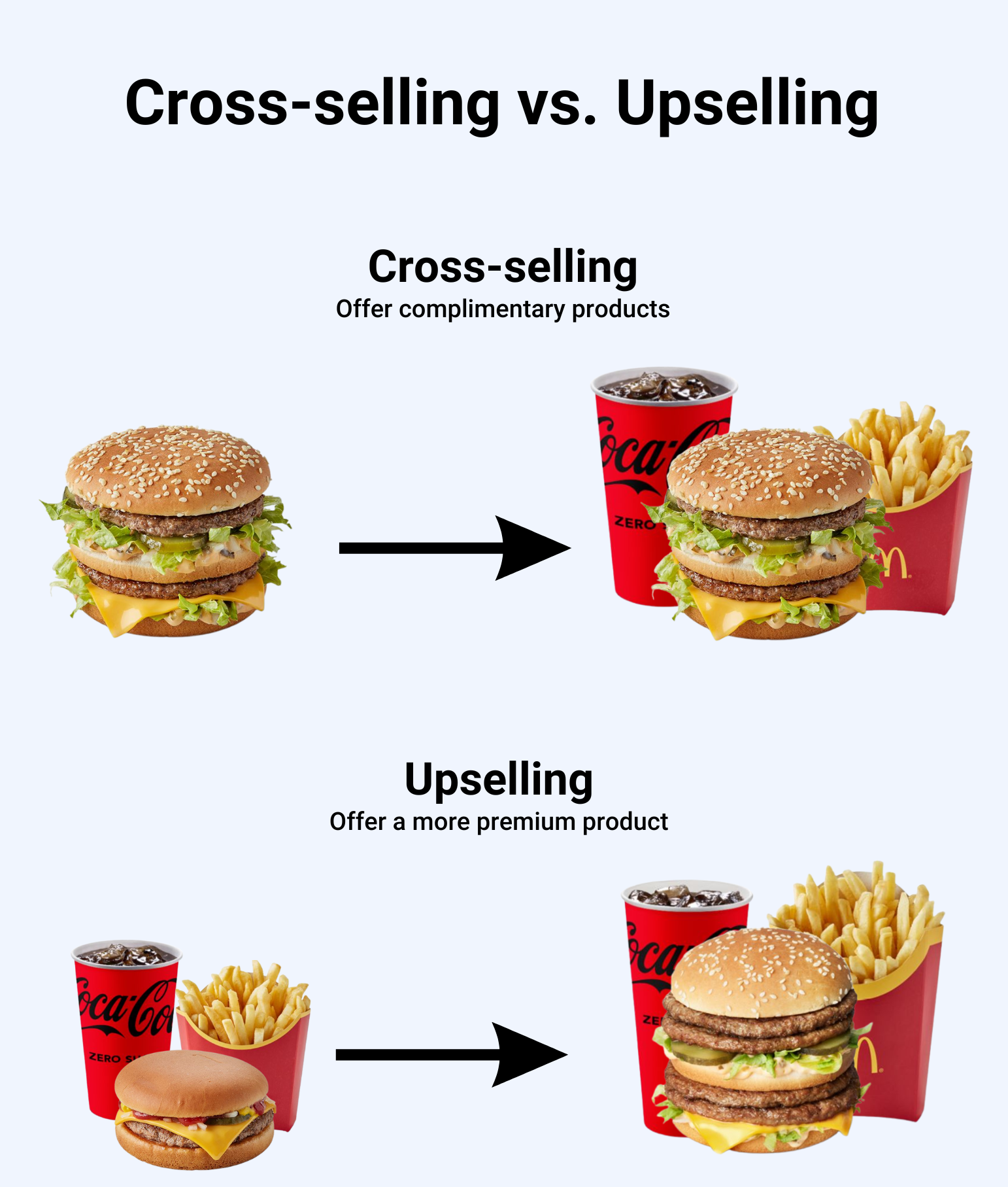
A lot of people mix these up, and that is understandable. They often show up in the same parts of the store. But they are not the same thing.
An upsell is a better version of the main purchase.
Examples:
A cross-sell is a related product that complements the main purchase.
Examples:
The easiest way to remember it is this:
The best stores usually use both. Upsells increase the value of the main buying decision. Cross-sells make the purchase more complete.
If you want more ideas on the cross-sell side, read 9 Cross-Selling Tips That Work Everytime (With Examples), one of the recent posts on the Upsell.com blog.
A few years ago, some stores could get away with weak monetization because traffic was easier to buy. That is a lot less true now.
In 2026, most store owners are under pressure from every direction:
That changes how you think. Instead of only asking how to increase traffic, you start asking how to increase the value of the traffic you already have.
That is why upselling matters so much. If somebody already landed on your store, explored your product, added something to cart, or even completed a purchase, you are already much closer to more revenue than you think.
You do not always need more visitors. Sometimes you just need a better offer.
That is why upselling is one of the highest-leverage improvements a store owner can make. It helps you grow revenue without relying entirely on more paid traffic, more discounts, or more desperate promotion.
If average order value is a major focus for you, How to Increase Average Order Value: 7 Proven Strategies That Boost AOV Fast is worth reading next. It is one of the blog’s newer AOV-focused guides.
The best way to upsell products is to make the upsell feel like the natural next step.
That means the offer should do at least one of these things:
A lot of stores overcomplicate this. They think upselling is about clever tactics. Most of the time, it is not. It is about merchandising, timing, and relevance.
If the offer does not clearly connect to the original product, do not show it.
The customer should immediately understand why the upgrade or recommendation exists.
One strong upsell usually performs better than a pile of mediocre suggestions.
Different upsells work in different places: product page, cart, checkout, post-purchase, thank-you page, and email.
The easier it is to accept the offer, the better it tends to convert. That is one reason post-purchase one-click offers work so well when done correctly.
If you want more ideas on where to spot those moments, read Upsell Opportunities: How to Find, Increase, and Automate Them. It is one of the most recent articles on the blog and fits this topic naturally.
Upselling a customer starts with understanding what they are actually trying to achieve.
That is where bad upsells fall apart. They focus too much on revenue and not enough on context.
A customer does not want “an upsell.” They want a better buying decision.
That means if you want to upsell a customer well, you need to ask:
The best upsells feel like guidance. That is true in ecommerce, in service businesses, in retail, and pretty much everywhere else.
If you run a Shopify store, upselling should be part of your store flow, not an afterthought.
A strong Shopify upsell setup usually includes:
Trying to stitch this together manually gets messy fast. That is why it makes sense to use a tool built specifically for it.
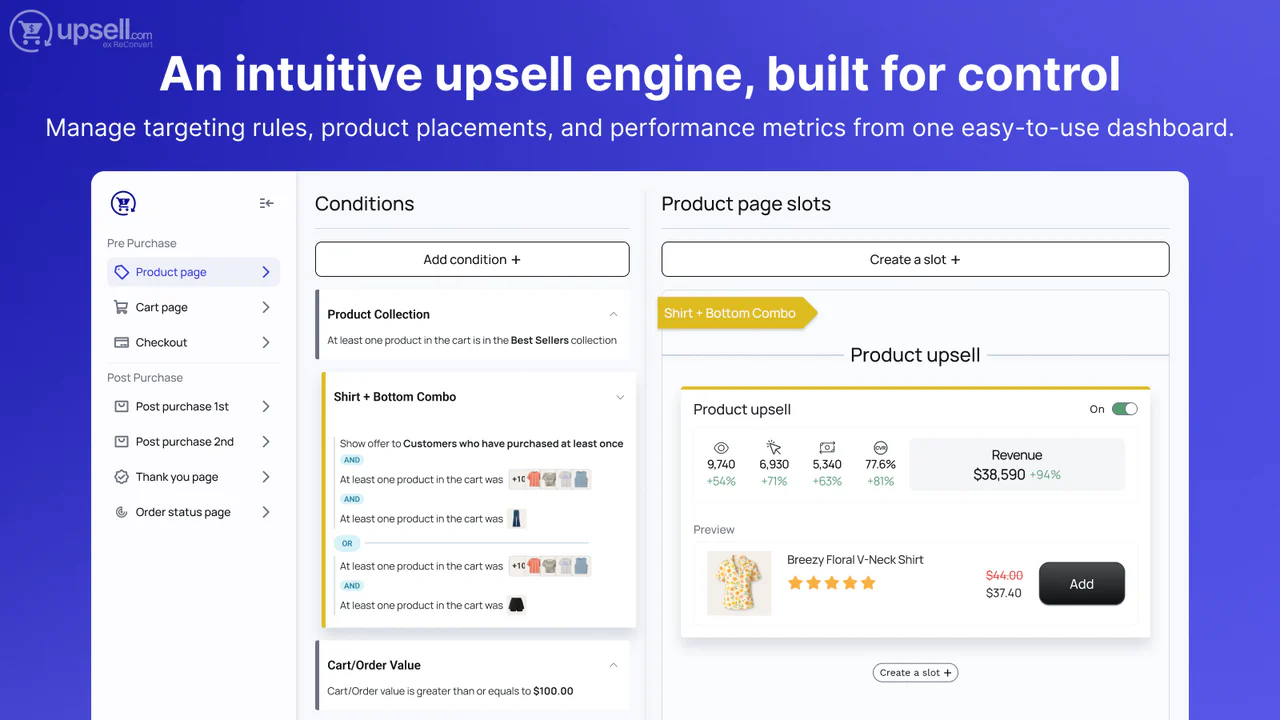
If your goal is to increase AOV without turning the store into a stack of disconnected widgets, take a look at Upsell.com. Its Shopify listing describes support for pre-purchase and post-purchase upsells, AI recommendations, cart upsells, one-click upsell funnels, and checkout upsells for Shopify Plus.
If you want to go deeper on the Shopify side, read How to Upsell Effectively on Shopify (2026 Guide) and Shopify Upsell at Checkout: The Complete Guide (Tips & Real-World Examples). Both are recent Shopify-specific articles on the blog.
If you are ready to put that into practice, Install Upsell.com for Shopify.
There are a lot of apps that can technically show offers. That is not the same as having a real upsell system.
If you are choosing based on what actually matters, look at this:
That is why Upsell.com is worth a serious look if your goal is revenue, not just having an app installed. Its Shopify App Store listing shows a Built for Shopify badge, a free plan and free trial, a 4.8 rating from 2,835 reviews, and messaging centered on offers throughout the customer journey.
You do not need more clutter. You need better offer placement and better execution.
Most upsell emails fail because they sound like marketing. Too polished. Too generic. Too detached from what the customer actually did.
A good upsell email should feel like a useful follow-up.
Mention what the customer bought, viewed, or showed interest in.
Do not overload the email with too many options.
Why is this better? Why now? Why does it matter?
Do not make the customer work to understand the next step.
If someone bought a starter skincare product, the email might say: “You’ve already got the cleanser. If you want better results, the serum is usually the next step.”
Upsell.com helps you increase AOV with targeted offers across the full shopping journey, from product and cart to checkout, post purchase, and beyond.
That feels far more human than generic promo copy.
For examples, read 9 Smart Ways to Use Upsell Emails (with Examples You Can Steal). It is one of the blog’s recent email-focused pieces.
Retail upselling works best when it feels conversational and useful.
The same rule applies: do not push random products. Help people make a better purchase.
In retail, upselling often comes down to:
The reason it works in retail is the same reason it works online: customers value confidence. If your recommendation helps them buy with more confidence, the upsell feels good. If it feels scripted or forced, it falls flat.
Upselling a service is usually about one of three things:
For example:
The trick is not to position it as “pay more.” You position it as better results, faster implementation, fewer headaches, stronger support, or more complete coverage.
You should try to upsell services when the customer is already seeing value and the next offer clearly improves the result.
Good times to upsell services:
Bad times to upsell services:
Existing customers are often your easiest upsell opportunity because trust already exists.
They already know your brand, product, shipping, support, and general quality level. That changes everything.
Good upsell opportunities for existing customers include:
In many stores, the easiest money is not in the first sale. It is in what happens after the first sale. That is why post-purchase offers, thank-you-page offers, and follow-up email flows matter so much.
If post-purchase is a priority for your store, read How to Upsell After Checkout on Shopify (With Examples) and 8 of the Best Order Bump Examples We’ve Seen. Both are recent and very relevant to this stage of the funnel.
Restaurant upselling is one of the clearest examples of good versus bad execution.
Bad upselling sounds robotic: “Do you want to add this, this, this, and this?”
Good upselling sounds natural:
The rule is the same: make the order better, not just bigger.
This is really about positioning.
If you want to upsell event attendees into memberships, the membership needs to feel like the natural continuation of the experience they already said yes to.
What usually works:
What usually does not work:
The best moment is often right after the attendee has had a good experience or is already excited about more access.
Most upsells fail for very predictable reasons.
If the offer does not make sense, it feels cheap.
A crowded page can hurt decision-making more than it helps.
Some offers belong on the product page. Some belong after checkout. Some belong in email. Timing matters.
If the offer looks bolted on or messy, trust drops fast.
A lot of store owners install an app and assume they now “do upsells.” That is not enough. You need to see what people actually accept and what lifts AOV.
If you are building upsells from scratch, keep it simple.
Do not try to optimize everything at once.
Ask yourself: what is the obvious better version of this purchase?
What naturally completes the purchase?
Think in layers: product page, cart, checkout, post-purchase, thank-you page, and email.
Watch acceptance rate, average order value, conversion rate impact, performance by placement, and performance by product.
The stores that get the most out of upselling are usually not the ones with the fanciest strategy. They are the ones that keep refining what is actually working.
If you want a simpler way to apply all of this in Shopify, Install Upsell.com for Shopify. If you are running on Wix, Install Upsell.com for Wix. The Wix listing describes a native checkout integration, 14-day free trial, Wix Choice badge, and analytics for tracking upsell performance.
Store owners in 2026 do not need more noise. They need cleaner systems.
Upselling works when it is relevant, well-placed, and easy to accept. It does not need to feel aggressive. It does not need to make the store feel gimmicky. And it definitely should not feel like a desperate attempt to squeeze more money out of every cart.
Done properly, upselling is just good selling.
It helps the customer buy better. It increases order value. And it gives you more revenue from the traffic you already worked hard to get.
If you are on Shopify or Wix and want to implement it properly, Upsell.com is worth a look. The Shopify app focuses on offers across the full journey, while the Wix app is centered on checkout upsells and cross-sells.
Upselling is encouraging a customer to buy a better, bigger, or higher-value version of the product they were already planning to buy.
Upsell means increasing the value of a purchase by guiding the buyer toward a more valuable version of the original decision.
An upsell is a better version of the main product. A cross-sell is a related product that complements the main purchase.
Keep the offer relevant, explain the value clearly, place it at the right moment, and avoid showing too many offers at once.
The best places are usually the product page, cart, checkout, post-purchase flow, thank-you page, and follow-up emails.
The easiest way is to use a dedicated Shopify upsell tool so your offers feel like part of the buying journey instead of random widgets.
That depends on your store, but if your focus is increasing average order value with cleaner upsell and cross-sell execution, Upsell.com is one of the stronger options to evaluate. Its Shopify listing shows a Built for Shopify badge, a 4.8 rating from 2,835 reviews, and support for upsells across the customer journey.
Yes. Upsell.com also has a Wix app listing that highlights checkout upsells and cross-sells, a 14-day free trial, a Wix Choice badge, and usage analytics.
Because the original purchase is already complete, trust is higher, and accepting another offer often feels easier.
Yes. If they are irrelevant, overly aggressive, badly timed, or clutter the experience, they can reduce trust and hurt conversion.
Yes. As traffic gets more expensive, increasing average order value becomes one of the smartest ways to grow revenue from the visitors you already have.
{{cool-component="/style"}}
ProductReConvert has officially become Upsell.com. Here’s what’s changed, what stays the same, and what this means for your Shopify store.
 Marketing
You don’t need a huge budget to get your business or brand noticed. Our online marketing ideas for small businesses are designed to maximize ROI.
 Marketing
eCommerce marketing automation allows you to free up time, provide a better experience, and ultimately, make more sales. Discover 10 simple, but proven eCommerce marketing automation examples you can implement to take your store to the next level.
Get eCommerce insights that convert
One email a month, practical strategies on conversion, AOV, retention, and customer experience.