.png)

10 Powerful Personalized Ecommerce Strategies That Deliver Jaw-Dropping Results [with examples]

eCommerce Personalization is massively underrated.
For a second, take a journey with us, through a store of the future:
Imagine, you walk up to the storefront, the windows each displaying an item that perfectly matches your tastes.
Once you enter, a sales associate greets you by name and points you to a few products that go perfectly with your last purchase.
While you’re checking out, the cashier suggests one last item you’ve been looking for, at a discounted price.
Okay, let’s step back into reality.
This isn’t a store of the future. It’s something that any merchant can create today using an ecommerce storefront.
In this post, we’ll teach you just how you can create a customer experience that’s perfectly tailored for every unique visitor.
What is Personalized eCommerce?
eCommerce shopping has its own strengths and weaknesses.
The strengths?
You can shop in whatever attire you want, at your own leisure, at any time.
The weaknesses?
eCommerce stores lack the personal aspect that in-person stores come with.
But that doesn’t mean you can’t make up for a lack of humans.
Personalization helps you fill that hole by adapting your store to each unique visitor. One familiar example of this is Amazon’s “products you might like” section.
Those products aren’t just guesses; Amazon uses tons of data to generate the perfect recommendations for each customer.
Offering ecommerce personalization isn’t just for show either. It delivers real results:
- 79% of organizations that exceeded revenue goals have a documented personalization strategy.
- 98% of retailers with personalization see an increase in AOV and 97% see an increase in revenue per user.
- 92% of shoppers have been influenced to buy from personalized shopping cart recommendations.
Wondering how to create this ‘store of the future’ personalized ecommerce experience for your store?
Let’s cover 10 ecommerce personalization tactics to create a high-converting customer experience.
1. Use Customer Segments to Tailor the Homepage
Whether the owners know it or not, every ecommerce store has customer segments.
First-time visitors versus high-frequency buyers.
Low spenders and bargain hunters versus top spenders. ]
City dwellers versus country mice.
Men versus women, mature versus young shoppers
The list goes on.
Yet so many ecommerce brands offer just a single home page experience for all customers, just like they would in a brick-and-mortar location where they’re limited to a single display.
Newsflash: There are practically infinite ways to customize the home page for every segment.
Here are a few simple ways to improve and tailor the customer experience by segment:
- Reorder or swap content blocks
- Promote a specific incentive or offer
- Choose a unique headline or call-to-action
- Change the navigation order or add/remove menu items
Personalized Ecommerce Example: CraftShack’s Homepage

CraftShack knows that every customer has their own unique preferences.
One person might favor IPAs, while another is all about sours.
To accommodate that, CraftShack offers a personalized ecommerce experience once a customer has repeatedly browsed or bought from a specific product category.
Within a single session, the home page content updates to show a visitor’s preferred beverage category from the get-go; a strategy that transfers between sessions too.
The result is a customer experience that offers less frustration and a faster journey to the checkout.
2. Help Customers Pick Up Where They Left Off
Online shopping has infamously high cart abandonment rates, but that’s not always due to poor optimization.
Often, it’s because a shopper was just browsing during a few minutes of downtime.
To recapture some of those browsers, you can use ecommerce personalization to identify returning shoppers and remind them to checkout.
To re-engage returning visitors, try the following:
- Send a cart abandonment email that reminds them of what they added to cart, and include personalized product recommendations for other items they may like
- Include a hello bar or pop-up banner tailored to the shopper that features their name and what’s in their cart, with a direct link to the cart
- Add ‘Recent Views’ to the bottom of your store’s pages to refresh shoppers on products they may have missed
Personalized Ecommerce Example: Wendell August Forge’s Recapture Strategy

It only makes sense that America’s oldest and largest forge, Wendell August, has an appreciation for history.
They provide ecommerce personalization by including Recently Viewed products on their homepage. This helps returning shoppers pick up right where they left off.
On top of that, they also use custom product recommendations in abandoned cart emails to drive more clicks and more conversions.
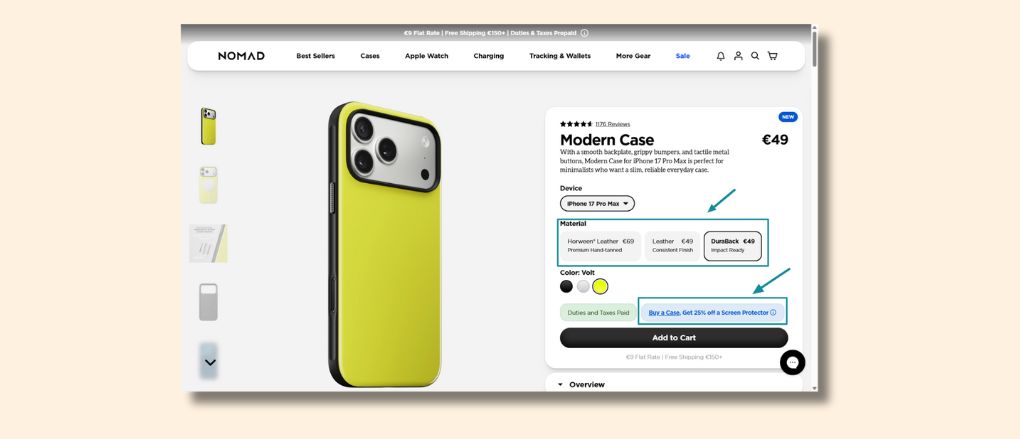
3. Offer Customized Cross-sells and Upsells
Everyone knows that cross-sells and upsells are simple tactics to generate more revenue for your business.
But a product recommendation is even more effective when tailored to each shopper.
In some cases, it may make perfect sense to cross-sell an item that goes with a specific product, for example, frames that fit a specific size of art print.
But having customized promotional offers will usually convert more reliably.
For example, a shopper looking at an art print may receive recommendations for minimalist frames based on the style of print they’re looking at - not just the size.
Taking into account product data, store-wide purchasing behavior, and individual shopper preferences is an ideal way to serve up the highest-converting ecommerce personalization offers possible that will also drive higher AOVs.
Personalized Ecommerce Example: ezpz’s Cross-Selling Strategy

Brands create matching sets for a reason:
To sell more to fans of a specific print, pattern, color, or finish. Children’s serveware brand “ezpz” leverages this type of ecommerce personalization to great effect.
They do this by offering specific products that match the color and age group of in-cart items.
The result is a more cohesive shopping experience for customers and more sales for the brand.
4. Personalize the Site Experience by Geography
Virtually every business has a slightly different experience based on where a shopper lives.
Forcing a shopper to dig for details on international shipping or return policies is a recipe for frustration.
Instead, save customers the hassle and direct each user to different instances based on IP. The results and benefits are clear - shoppers are less frustrated and more likely to checkout.
Here are a few ideas to provide a personalized ecommerce experience by geographic location:
- Change currency and language
- Update site policies
- Highlight unique promotions
- Tailor featured collections or hero images based on climate
- Point to nearby brick-and-mortar locations
- Check local inventory for BOPIS or click & collect services
Geography Personalized Ecommerce Example
The GAP family of brands really makes an effort to drive as many local sales as possible, which makes sense given they've got one of the wider retail footprints across the globe.
This ecommerce personalization tactic is used to automatically pull up the nearest retail location for a brand and offer an option for shoppers to click & collect their order, assuming it's in stock locally.
5. Organize Collections by Customer Preference
For many customers, their journey starts on the collection pages.
But rather than assume every customer is going to love a standard merchandising setup, consider offering ecommerce personalization by tailoring the collection sort order to a buyer’s preferences.
Look at the brands or products they buy from on a regular basis and auto-filter those products toward the top for an ultra-personalized ecommerce touch.
Another clever idea? Pin products to the top of a collection that you want to sell more of.
You can tailor collection sort orders by:
- Browsing behavior
- Purchase history
- Brands
- Colors
- Price points
- Popularity
- And more
Personalized Ecommerce Example: Wine Chateau

Red or white? Sparkling or still? European or North American?
Wine preferences are incredibly varied and given Wine Chateau has thousands of SKUs, they knew they needed a way to help shoppers get to their favorite varietals that much quicker.
They use an ecommerce personalization strategy to sort products into segments based on customer data.
When shoppers visit a specific broad collection like what’s new or white wine, their favorites are automatically surfaced toward the top. We’ll toast to this amazing customer experience strategy.
6. Recommend Products in Email
Your website isn’t the only place to offer ecommerce personalization.
Email is just as effective, particularly when product recommendation emails are updated in real-time based on shoppers’ latest purchases.
👉Pro tip: Try adding product recommendations to transactional emails like an order or shipping confirmation.
7. Allow Your Customers to Filter Reviews
Shoppers want to know they’re getting the best advice possible.
And one tactic that helps increase trust is to let them sort out reviews that match their tastes.
To help customers find relevant reviews, let them filter searches for anything from star rating to height or size.
Let customers find the most relevant reviews, and they’ll be more likely to find a match that’ll make them confident enough to buy.
8. Create AI-generated Personalized Collections
What if every individual shopper had a collection tailored *just* to them?
This type of personalized experience is possible, on autopilot, with AI-driven product recommendations.
The secret is to lay product recommendations out in a grid format.
Add a menu item called ‘My Collection’ or put it in the customer’s account center and they’ll be automatically served up a suite of items tailored to their personal preferences and tastes - one that updates in real-time, even within a single session.
This idea works particularly well for brands that offer b2b ecommerce.
Customers are more likely to want to reorder a product or look at similar products to what they've already purchased. A personalized collection makes it super easy for them to browse and buy.
Personalized Ecommerce Example: The Spark Company

Where better to place a grid of product recommendations than the home page?
Instead of relying on a single strip of items to reel in customers, grid-style layouts help The Spark Company improve the UX of their site.
This grid format allows customers to view entire collections at once without scrolling through multiple pages.
Although not quite as advanced as creating a user-adapting collection page, it’s still a great way for The Spark to showcase highly relevant products to their customers.
9. Use Quizzes to Guide Customers to the Right Products
It’s a simple fact: Shoppers are conditioned to love quizzes. (at least, the right kind of quizzes)
Quizzes are a bit like ecommerce horoscopes: Whatever result you get, you’re more likely to believe it’s right because it’s based on you.
A product discovery quiz can be an effective customer engagement tool to convert shoppers based on recommendations.
Think of it this way: Would you rather buy a sitewide bestseller, or a 5-star product specifically recommended for your tastes?
Personalized Ecommerce Example: Bombas

At first glance it might not seem like socks are a likely category in need of a lot of product customization.
But socks come in all shapes and sizes. Different sizes, heights, fabrics, colors, or even general styles.
And each customer will have a different preference on each of those factors.
Bombas helps shoppers ensure the sock fits (never mind the shoe) by offering up a helpful quiz to direct new customers to their ideal products.
10. Create a Riveting Post-purchase Experience
We can’t tell you how many times we’ve seen brands miss the boat when it comes to the post-purchase experience.
Just because you’ve converted a customer, doesn’t mean they’re a signed, sealed, delivered happy shopper.
The post-purchase experience is an opportunity to really sweeten the experience and make shoppers feel a happy glow even before they receive your parcel - like sending a thank you note after a job interview or flowers after a date.
Consider including a handwritten message in the package, or include a free gift for new shoppers.
But don’t reserve this tactic for just new customers.
You can also use a post-purchase plugin like Upsell.com to add Amazon-style thank you pages to your store.
And each of those thank you pages can be filled with custom offers for each customer, to raise your bottom line even further.
Treat your VIPs and longtime fans with some respect as well - celebrate milestones like hitting a new level in your loyalty program, birthdays, or first purchase anniversaries with extra special touches.
Rome Wasn’t Built in a Day… But Your eCommerce Personalization Strategy Can Be
Let’s be real.
An effective web personalization strategy accounts for every possible touchpoint a customer has with your brand, and then tailors those touchpoints to each customer.
Here are a few closing tips to recap what we’ve covered today:
- Use adaptive pages to display cross-sells based on customer purchase history.
- Implement cookies on your site so you can recommend previously-viewed products.
- Send re-capture emails for abandoned carts.
- Use quizzes to tailor recommendations to each customer’s needs.
- Implement a post-purchase strategy to boost your AOV even further.
All of that might seem like a lot of work, but there are some personalized ecommerce tactics that can be managed on autopilot.
With the help of customer data and an AI-driven personalization tool like LimeSpot.
Generate automatic recommendations, personalized email widgets, tailored website content, and more based on shopper behavior, purchase histories, trends, geography, or whatever segmentation criteria you can imagine.
The choice is yours with a robust personalization platform - the possibilities are endless. 3.


.png)
