 Marketing
10 Practical Marketing Ideas For Small Businesses
You don’t need a huge budget to get your business or brand noticed. Our online marketing ideas for small businesses are designed to maximize ROI.
Shopify post purchase upsells are probably the most underrated strategy to generate more revenue from your store.
Seriously, imagine you could serve targeted offers to customers immediately after they purchase. Like when a customer buys a pair of running shoes, and you immediately offer them 30% off a pair of running socks.
On Shopify, post-purchase upselling is part science and part an art form. It's about suggesting items your customers didn't know they needed, creating connections after every transaction., and taking home more profit.
In this guide, we'll unravel Shopify Post Purchase Upselling from what it is to how to integrate it seamlessly into your store. The best bit is that you don’t need to know how to code, or be a conversion rate optimization pro.
Whether you're a seasoned merchant or just starting out, get ready to unlock a new level of revenue potential.
Here’s why it’s worth building: across real, anonymized data from stores running Upsell.com (formerly ReConvert), post-purchase placements — the offers shown after checkout, before the thank-you page — account for 67.9% of every after-payment conversion, more than any other spot in the store. Show a second offer and roughly 21 more shoppers out of every 100 who accept take it too (closer to 27 in December). We cover the full placement breakdown in our post-purchase upsell statistics report — this guide is about how to actually build one.
Post-purchase placements convert more often than any other spot in the store — 67.9% of every after-payment upsell on Upsell.com (formerly ReConvert) happens here.
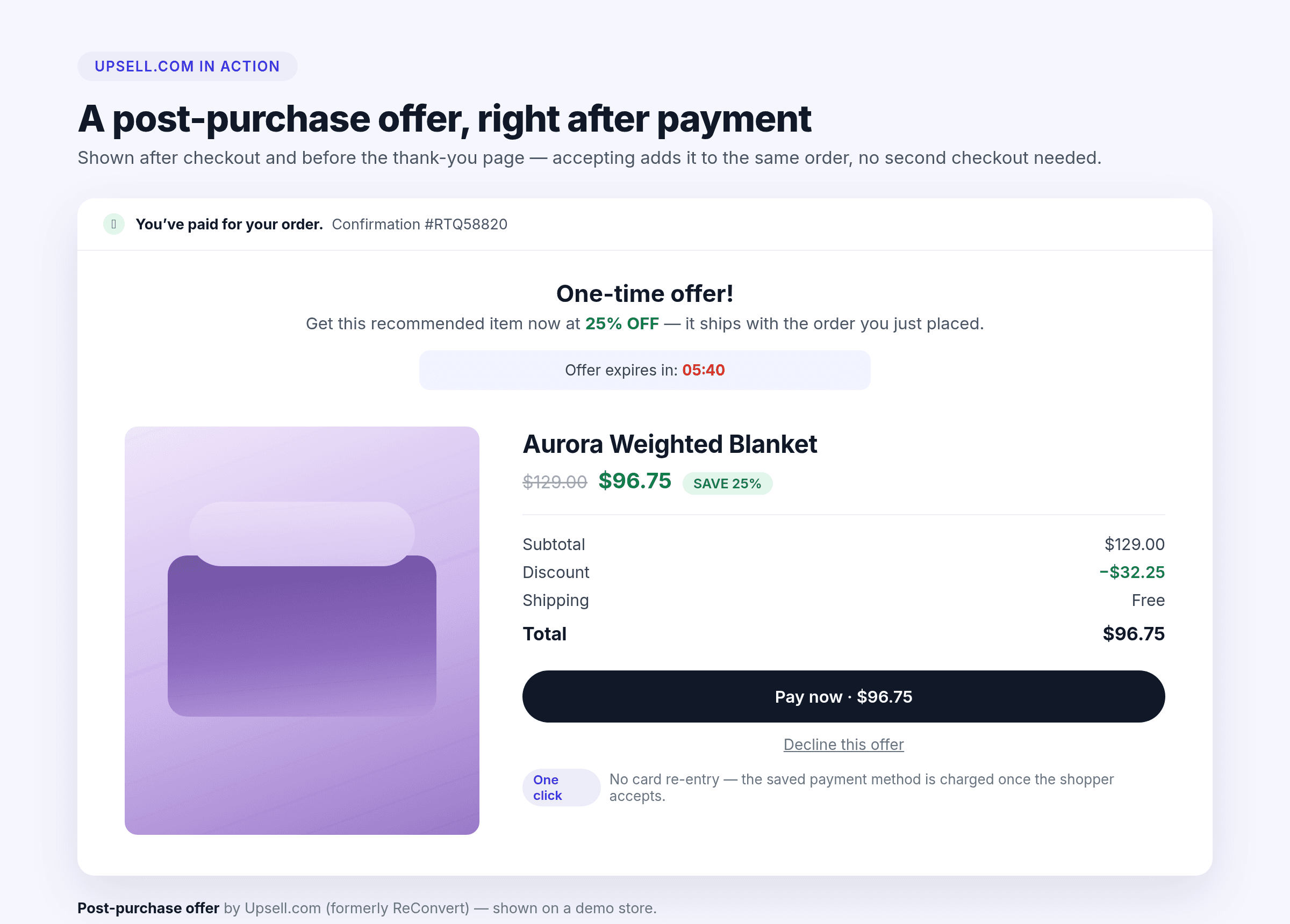
At its core, a Shopify Post Purchase Upsell is an offer you serve to customers, after they’ve completed their initial purchase (it’s in the name!).
A post-purchase upsell is an extra nudge after a customer makes a purchase, encouraging them to add more value to their order - and more beef to your bottom line.
There are two main types of post-purchase upsells that thrive in the Shopify ecosystem:
One-click upsells are offers presented immediately after a customer makes a purchase. They're designed for speed and convenience.
So, imagine your customer has just bought a sleek smartphone case from your store.
With one-click upsells, you could seamlessly present them with options like a screen protector, a wireless charger, or stylish earbuds that perfectly complement their purchase.
It's about anticipating their needs and offering solutions in a heartbeat.
Once a customer completes their order, they land on the all-important order confirmation page (also referred to as the thank you page).
Your Shopify thank you page is a massive source of untapped potential. Seriously, it’s the piece of the puzzle that most retailers miss.
Thank-you-page upsells convert on 18.5% of all after-payment orders — the steadiest placement in the store across the year. See the breakdown in our thank you page statistics report.
Because here, you have the attention of highly-qualified shoppers who are in peak-buying mode. It makes no sense to waste these valuable impressions on a placeholder page.
Instead, your thank you page is the ideal moment to showcase related or complementary products that enhance their original purchase.
The beauty is that you can laser target your product suggestions based on the items your customer purchased just moments ago.
Whether it's suggesting a matching accessory or a premium version of the item they just bought, it's all about maximizing value at this critical touchpoint. For even more sales, you can also add additional offers to your order status page on Shopify.
By strategically incorporating one click-upsells and thank you page offers into your Shopify store, you're not just going to make more sales. You’re also providing a personalized shopping experience that leaves a lasting impression.
📖Suggested Reading: 8 of the Best Thank You Page Examples for More Conversions
Now that you know the two most powerful post-purchase upselling strategies, let’s quickly look at the benefits of Shopify Post Purchase Upsells.
The frictionless nature of post-purchase upsells means customers find them hard to resist. Think about it: post-purchase upsells are served at the pinnacle of purchase intent.
And better yet, customers don't need to re-enter payment or delivery details, so friction is completely minimized.
Plus, since you know what customers bought, post-purchase upsells are incredibly easy to personalize, which can drive conversion rates higher.
Comparing the conversion rate of post-purchase upsells with other upselling strategies, such as email, shows a stark difference.
For example, luxury food retailer Laumiere Gourmet Fruits, achieved a 7.01% conversion rate on their post-purchase offers and added a whopping 10% to their revenue in under 3 months.
While post-purchase upselling via email is still a valuable strategy, you’d be happy to achieve a click-through rate of 7.01%. A purchase conversion rate that high would be almost impossible to achieve.
The main benefit of shopify post purchase upsells is they allow you to make more profit.
Think about it: if your acquisition costs and fulfillment costs remain the same, then more sales translate to a bigger profit margin.
For example, let’s suppose you sell cookware. So, you invest $5,000 to create a digital product (e.g. An e-cookbook to compliment your products). Then you install Upsell.com and place your ebook as one click upsell offer.
Let’s say that your ebook offer increases your AOV by $5, here’s how this would look in real terms:

As you can see, even with increased expenses ($5,000 for the e-book and $360 for one year of Upsell.com) we’re making much more profit from our store.
Without spending another cent on ads, post-purchase upsells amp your advertising campaigns by providing greater ROI for the same outlay.
This means that effective upsells can transform a previously unprofitable paid advertising campaign into a profitable one.
Plus, a higher profit margin gives you more wiggle room with your ad spend to try new things.
Essentially, the core takeaway is that small increases in your AOV from upsells, can translate to big increases in profits and company growth.
Unlike pre-purchase upsells that might disrupt the shopping experience, post-purchase upsells are reserved for customers who've already made a purchase.
This might seem like a moot point, but you may be surprised at how loading the customer journey with pre-purchase upsells can unintentionally affect your conversion rate.
For example, just three months after installing Upsell.com, Lucyd saw a 5.6% boost in their net revenue directly attributable to their thank-you page upsells.
“What we’re seeing is a lot of customers who are coming back and buying something within a couple of minutes,” says Harrison Gross, CEO of Lucyd.
“When you think about it, It’s a much more logical customer journey compared with mid-sale upsells where you’re trying to sell to shoppers who may not be ready to buy yet” adds Harrision.
Essentially, post purchase upsells pose no risk to your existing conversion rate. It's all about enhancing the customer journey in a way that feels organic and customer-centric.
Similarly, tools like TxtCart's conversational AI can re-engage customers who have already made a purchase by upselling them with personalized SMS messages that sound eerily human. Something like 'Hey, noticed you bought X (great choice!) and thought you might also like Y to go with it. If you're interested, I can send over a 30% discount code just for you '.
Brands using this new approach can naturally upsell products, drive more SMS revenue without coming off "salsey", and show customers they truly understand their needs.
Many marketing strategies and CRO tactics are expensive and time consuming to implement.
For example, it’s easy to spend thousands of dollars on a CRO audit, to eek out an extra 2% in sales.
Similarly, building a well-oiled email marketing strategy is pretty difficult and requires a lot of expertise and time.
But implementing a post-purchase upsell strategy? It’s incredibly easy, it’s inexpensive, and with an app like Upsell.com, it doesn’t take more than a few minutes to go live.
In fact, you could launch a post-purchase upsell funnel on your store, before you finish reading this post. You don’t need to know how to code or be a CRO genius.
Upsell.com automatically builds a high-converting post-purchase funnel for your store, based on real, anonymized data from thousands of active stores.
Seriously, post-purchase upsells are like the pareto principle applied to your store. Implementing them is the 20% effort that drives 80% of the results.
The easiest way to add post purchase upsells on Shopify is with Upsell.com. Upsell.com is a purpose built post-purchase upselling app that makes adding upsells to Shopify a breeze.
Here’s how to do it:
The first step is to head over to the app store and add Upsell.com.
Why Upsell.com? It’s one of the most-reviewed post-purchase upselling apps on Shopify — rated 4.8 out of 5 from 3,144 reviews on the Shopify App Store (as of November 2026), and trusted by thousands of stores.
Once installed, find Upsell.com in the apps section of your Shopify dashboard. Click the app, then navigate to the funnels tab.
Here you can choose Upsell.com's template ‘Conversion Monster Funnel’, or you can create your own funnel from scratch by clicking ‘Create a new funnel’.
If you’re new to Shopify post purchase upsells, and want a quick set-up choose the ‘conversion monster funnel’. If you want to create something more custom, then we recommend creating your own funnel to reach your specific goals.
Now you want to build the flow your customers go through when they complete checkout. The funnel builder is pretty intuitive - If you’ve used any email automation software it’ll be super familiar for you.
Your funnel is the flow that customers go through when they successfully complete a checkout. Use the funnel editor to:
Building a one-click upsell funnel takes just a few minutes.
Next you’ll want to transform your order confirmation page from a placeholder into an upselling opportunity.
Here’s how to do this:
Upsell.com helps you increase AOV with targeted offers across the full shopping journey, from product and cart to checkout, post purchase, and beyond.
Next, you can edit your upsell offer using the widget menu to change things like the product, price, shipping, call to action and more.
You can also select the conditions to show your offer or integrate with apps like Wiser to display dynamic product recommendations based on the user's browsing history.
Check out our help article for more information, and specific steps to build a thank you page upsell that meets your goals.
Shopify doesn’t allow popups on the thank-you or order status page — full stop, on any plan, by any app. So Upsell.com’s Announcement Bar does the job a popup would: a sticky bar at the top of the page with a time-limited discount and a live countdown. It runs on the thank-you page and order status page, the discount auto-applies, and it follows the shopper back into your store — so the urgency doesn’t end the moment they close the tab.
Turn it on from your Thank You Page or Order Status Page settings, set your discount and countdown window, and save. For the full walkthrough, see our help article on the Announcement Bar.
Once you’re happy with your thank you page upsells and announcement bar, click save, set your whole post-purchase funnel live, and get ready for additional sales to roll in.
It’s often said that a good example is better than a good idea. So let’s look at a few examples of well-executed post-purchase upsells on Shopify.
Last year, Laumière Gourmet Fruits faced a challenge: escalating advertising costs per impression (CPMs) were shrinking the brands profit margin.
Unwilling to skimp on product quality, co-founder Varun Sharma, looked for another way to offset these increasing costs.
He turned to Upsell.com and created a series of thank you page upsells. The main offer allowed customers to pick up a second box of chocolates for between 5-20% off the original price.
The results of these thank you page upsells were striking. Upsell.com propelled Laumière to a record-breaking Q4, contributing a substantial 10% increase in gross revenue, representing a remarkable 4,246% return on investment.
On a typical Upsell.com setup, the moment a customer clicks ‘complete purchase’, they’re immediately redirected to the post-purchase upsell offer page — as shown in the example near the top of this guide.
As we mentioned above, this represents the first step of the post-purchase upsell funnel. Should the customer decline the offer, you can add on an additional upsell or downsell offer before redirecting them to the thank you page.
Not all post-purchase offers are created equally. Let’s look at the five core elements that underpin the best post-purchase upsells. By implementing these five concepts into your post-purchase strategy, you’ll get more conversions and generate more revenue.
When items are scarce, they’re often perceived as more valuable. So, add an element of scarcity and urgency to your post-purchase offers. A simple countdown timer can work well. When customers feel like they need to act quickly, they’re more likely to convert. Especially if your offer is exclusive to the transaction, and can’t be claimed again.
According to NetCore, personalization makes 28% of buyers more likely to buy a product they didn't mean to buy. What’s more, 26% say it may drive them to buy something more costly than expected. So, tailor your offers with triggers and segmentation. Use your analytics to find which offers resonate best with your customer segments. Then double down on your best performing offers.
Friction is the enemy of conversion. Seriously, the more steps a customer needs to take, the less likely they are to convert. This goes for every aspect of your eCommerce strategy. So, ensure post-purchase offers can be claimed with as little effort as possible - ideally in a single click.
The more choice a customer has, the more they need to consider their options. Limit your post-purchase offers to a maximum of three options. Ideally, never present more than one option at the same time. Again, limiting choice is about reducing friction. You don’t want the opportunity cost of additional options canceling out each other's appeal.
Most shoppers will still decline a post-purchase offer, even a well-designed one. So, make it easy to opt out. The last thing you want is for your post-purchase offers to harm customer opinion of your brand. Use no more than three one-click upsells (an upsell, a second offer, and a downsell).
With the best post purchase upselling best practices under our belts, let’s review the best Shopify post purchase upsell apps. These apps will help you implement post-purchase upsells without the need to code or access the Shopify post-purchase API.
Upsell.com is one of the most popular post-purchase upsell apps on Shopify, rated 4.8 out of 5 from 3,144 reviews on the Shopify App Store (as of November 2026) — among the highest review counts of any app on this list.
Upsell.com allows you to seamlessly launch a complete post-purchase upselling strategy in a few clicks. The app comes with a data-backed upselling template called ‘Conversion Monster’ which means all you need to do is select your discount value and the app takes care of the rest.
If you’d rather get more granular with your offers, Upsell.com has powerful segmentation and targeting tools. These tools allow you to personalize your offers, delight your customers, and drive more conversions.
Plus, support-wise, Upsell.com is the best of the bunch. Upsell.com boasts 24/7 support from conversion rate optimization pros. So, if you run into any issues, or need help creating more powerful offers, simply hop on the live chat and get the help you need, when you need it.
Shopify App Store Rating: 4.8/5 (3,144 reviews, as of November 2026)
Bold upsells is another powerful Shopify post-purchase upsell app. Bold has a reputation for building useful apps, and their upsell solution is no different.
Bold allows you to create post-purchase upsell funnels, as well as thank you page offers. The app has a user-friendly interface which makes it easy to create and launch offers.
We like that Bold also offers pre-purchase upselling functionality - it’s a great solution if you’re looking for one of the best in-cart upselling apps.
One thing to consider with Bold upsell is that users have reported compatibility issues with certain themes.
Some reviews report that even after uninstalling the app, lots of code remains on their sites - which can affect page loading speed and ultimately harm your conversion rate. So, we strongly recommend checking with their support before installing to ensure your theme is compatible with the app.
Lastly, if you want to offer discounted upsells (which is best practice), you need to pay for another app, Bold Discounts. So, ensure you calculate the total cost of both apps, before making a decision to use the product.
Shopify App Store Rating: 4.4/5 (598 reviews, as of November 2026). No free plan — paid tiers from $4.99/month with a 7-day trial.
Honeycomb is another Shopify post purchase upsell app to consider. Honeycomb is one of the newer upsell apps on the market, so isn’t as time-tested as either Upsell.com or Bold.
That said, the app is generally appreciated by its users. Like Upsell.com, Honeycomb allows you to build post-purchase upsells and thank you page offers. The app has an intuitive interface and offers basic customization and targeting.
The a/b funnel testing feature is nice - which means you can quickly optimize your post-purchase offers for better conversion rates.
But the app’s ability to create customized thank you pages is somewhat lacking. For example, at the time of testing, you can’t add post-purchase surveys or collect customer birthdays on the Honeycomb thank you page.
Some reviews also mention that support is lacking. The lower ratings cite how users were unable to contact support when they needed it. Long response times and somewhat unhelpful solutions are cited as reasons for uninstalling the app.
In our test we found that Honeycomb responded within 30 minutes to our query - which is pretty good. However, at a critical time (e.g. Black Friday) most merchants would prefer a much faster response. Upsell.com support responded to the same query in under 3 minutes.
Shopify App Store Rating: 4.7/5 (159 reviews, as of November 2026)
Carthooks is a decent Shopify post purchase upsell app. It’s simple to use and is good for those who want to dip their toe in the world of post-purchase optimization. The user interface is nice and from the limited selection of reviews, it appears that support is pretty good.
CartHook’s App Store listing doesn’t advertise thank-you-page upsells — its feature set centers on one-click post-purchase offers. In our data, thank-you-page upsells account for 18.5% of every after-payment conversion, so a dedicated thank-you-page offer is worth having alongside a one-click upsell.
Shopify App Store Rating: 4.1/5 (91 reviews, as of November 2026)
Aftersell is another good post purchase upsell app for Shopify. Users recommend Aftersell for its features like A/B testing, customizable thank you pages, and trust badges.
Aftersell is reliable, provides insightful analytics, and is suitable for both new and experienced merchants. The customer support team is generally good and they provide quick and personalized assistance.
While Aftersell is a great app - it doesn’t integrate with major email marketing platforms. Which means if you wish to enhance your post-purchase campaign with targeted emails, you’ll need to pair it with a separate email platform.
A post-purchase upsell is an offer shown to a customer after they’ve already paid — like getting a second, post-purchase email with a 100% open rate, because the shopper is still right there on the confirmation screen. Accepting it adds the item to the order that was just placed, with no second checkout.
Two is the sweet spot for most stores. In the data above, adding a second offer after the first brings in roughly 21 more accepted offers per 100 (about 27 in December) — stacking a third tends to add friction without adding much revenue.
No — it appears after the order is already paid for, not before or during checkout. Payment is already captured, so there’s no added risk to the sale itself; it’s closer to money that was otherwise left on the table.
They’re related but not identical. A post-purchase offer (sometimes called a one-click upsell) appears on its own page right after payment, before the thank-you page. A thank-you-page upsell sits on the order confirmation page itself — see our thank you page statistics report for how that placement performs on its own.
The placement and discount figures in this guide come from real, anonymized conversion data recorded by Upsell.com (formerly ReConvert) across its merchant base over a 12-month period, and are also covered in our post-purchase upsell statistics and Upsell statistics reports. If you cite these numbers, please link back to this page or to upsell.com.
MarketingYou don’t need a huge budget to get your business or brand noticed. Our online marketing ideas for small businesses are designed to maximize ROI.
 Marketing
eCommerce marketing automation allows you to free up time, provide a better experience, and ultimately, make more sales. Discover 10 simple, but proven eCommerce marketing automation examples you can implement to take your store to the next level.
 Product
ReConvert has officially become Upsell.com. Here’s what’s changed, what stays the same, and what this means for your Shopify store.
Get eCommerce insights that convert
One email a month, practical strategies on conversion, AOV, retention, and customer experience.