 Marketing
eCommerce Personalization: 6 Simple Strategies to Skyrocket Conversions
Personalizing your buyers journey is a fantastic way to boost conversions. Discover 6 simple ecommerce personalization tactics to try today.
If you've searched "AfterSell alternatives," you're probably already running a Shopify store that converts well enough after checkout to know the post-purchase moment matters — you're just not sure AfterSell is the app you want running it. Fair. It's a crowded corner of the App Store, and most of the comparison posts you'll find are written by one of the apps being compared (we'll admit upfront: so is this one — but we're one of the few that will show you real numbers instead of just claims).
So let's get into it: seven apps that handle the post-purchase upsell — the offer a shopper sees after they've paid but before they land on the thank-you page — compared on what they actually do, who they fit, and how their pricing is structured. Upsell.com is one of the seven, and we've labeled our own section the same way we labeled everyone else's.
Quick definition before the comparison, because "post-purchase upsell" gets used loosely. A post-purchase upsell app inserts one or more offer screens into the gap between "payment accepted" and "thank-you page." The shopper has already entered their card details once, for the original order — accepting the offer adds the new item to that same order with a single click, no second checkout, no re-entering a card number.
Think of it as the Shopify equivalent of the "customers who bought this also bought…" email Amazon sends you an hour after you order — except it arrives while the shopper is still looking at the screen, with a 100% open rate, instead of competing with their inbox three days later. eBay and AliExpress run versions of the same idea at checkout; Upsell.com (and every app below) brings it to Shopify specifically.
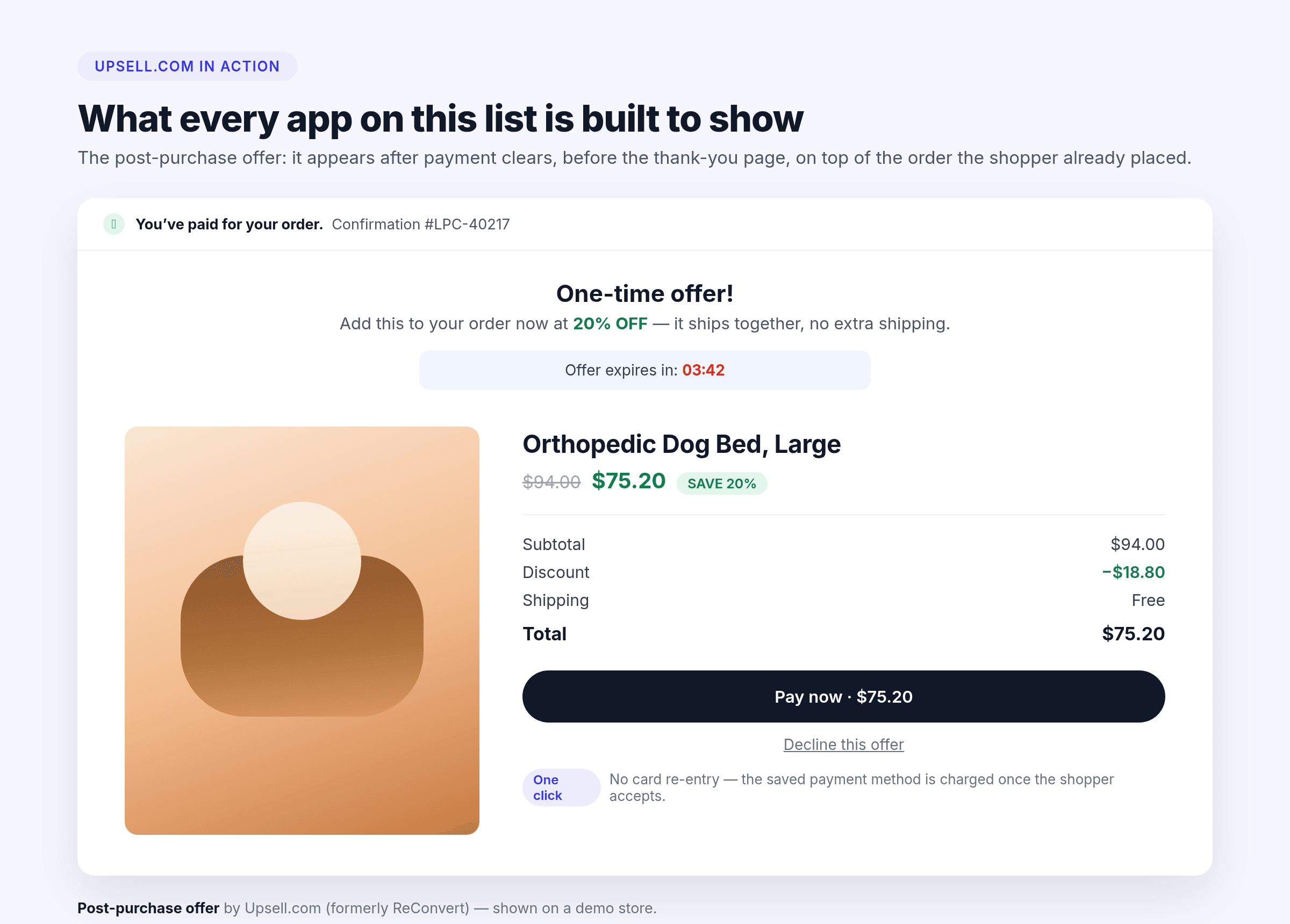
That's the screen every app on this list is competing to build the best version of. Here's how seven of them stack up.
Across real Upsell.com stores, the post-purchase screen accounts for 67.9% of every after-payment upsell conversion — which is exactly why seven different apps are built to own that one moment.
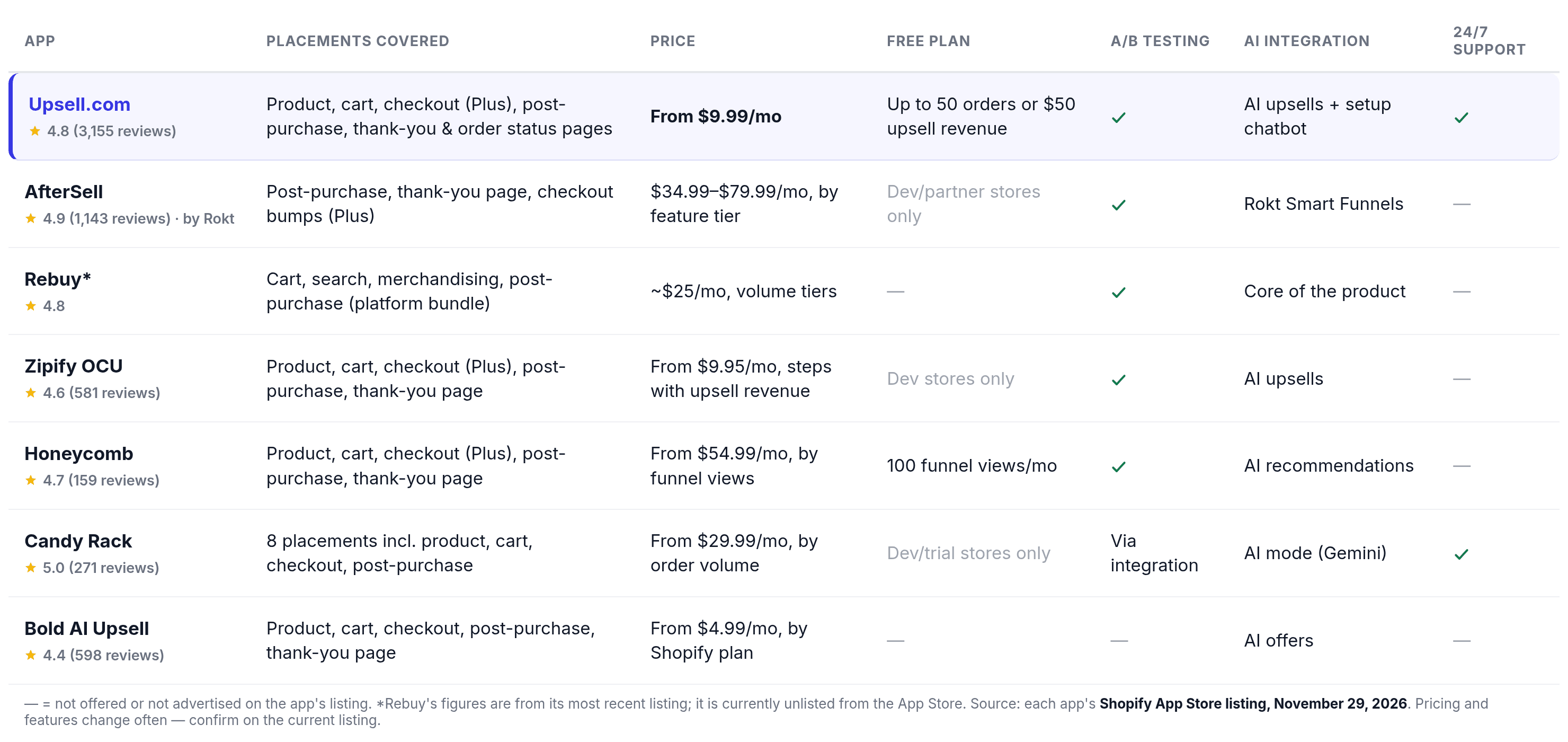
The quick read: Upsell.com covers the most placements (including the order status page nobody else touches), carries by far the most reviews at a 4.8 rating, includes A/B testing, AI and 24/7 support on every plan, and has the most generous free plan — up to 50 orders or $50 in upsell revenue a month. AfterSell and Zipify are dedicated funnel specialists, Rebuy is the (pricier) full personalization platform, and Honeycomb, Candy Rack and Bold each trade breadth or pricing differently. The details on each, below.
AfterSell is the app most people searching this term already have open in another tab. It builds post-purchase upsell and downsell funnels, a customizable thank-you page, and A/B testing; Shopify Plus stores also get checkout-level order bumps and social proof. Its "Smart Funnels" feature uses Rokt's own AI to pick which offer to show a given shopper. There's no free plan for live stores (free access is limited to development and partner stores); paid plans are flat, feature-based tiers rather than volume pricing — $34.99/month for Post-Purchase, $59.99/month for Pre-Purchase, or $79.99/month for the Complete bundle, each with a 30-day trial. AfterSell is a solid fit for stores that want funnel building and checkout bumps in one app and don't need deep thank-you-page customization.
Rebuy is less a single upsell app and more a personalization platform that happens to include post-purchase offers as one of four bundled packages (the others cover cart/merchandising, search/collections, and flows/A/B testing). Its post-purchase piece sits inside "Rebuy Monetize." That breadth is the draw and the tradeoff: you're buying a wider toolkit, with a steeper learning curve for the merchandising rules, and entry pricing that starts around $25/month on the lowest volume tier, scaling well beyond that at higher tiers. (Its App Store listing is currently unavailable too — confirm status with Rebuy directly.) Rebuy fits stores that want one platform handling recommendations everywhere — cart, search, and post-purchase — rather than a dedicated post-purchase specialist.
Zipify's OCU is one of the older, more established names here, built specifically around pre- and post-purchase upsell funnels across the product page, thank-you page, and the Shop app, with unlimited A/B testing and an analytics dashboard. Its published pricing starts at $9.95/month while you earn up to $200 a month in upsell revenue, then $25/month from $200–$2,500 in monthly upsell revenue, then $149/month above that — with total charges capped at $999/month even for the largest stores. That revenue-stepped structure is worth doing the math on if your upsell volume is already high. OCU suits merchants who specifically want a dedicated funnel-building tool and are comfortable with a usage-based fee layered on top of the base price.
Honeycomb spreads its offers across more of the journey than most of this list — product page, cart, post-purchase, and thank-you page — with an AI recommendation layer and a free plan capped at a low monthly view count. Paid tiers are priced by monthly funnel views rather than order count, which is a meaningfully different metric to budget against if your store gets a lot of traffic relative to orders. It's a reasonable fit for stores that want one app covering several placements at once rather than specializing in the post-purchase moment alone.
Upsell.com helps you increase AOV with targeted offers across the full shopping journey, from product and cart to checkout, post purchase, and beyond.
Candy Rack, from the same team as Candy Cart, is a pre- and post-purchase upsell app spanning eight placements, including the product page, cart, checkout, and post-purchase, with tiered pricing that scales by monthly order volume — $29.99/month for up to 50 orders, up to $59.99/month for 201–500 orders. The same developer ships a separate, dedicated post-purchase app under the name Last Upsell, which starts at a lower entry price (around $19.99/month). If you specifically want a post-purchase-only tool rather than a bundled pre- and post-purchase suite, it's worth comparing Last Upsell directly rather than Candy Rack's full package.
Bold has been in the Shopify upsell space the longest of anyone on this list. Its current app, rebranded as Bold AI Upsell & Cross-Sell, prices by your Shopify plan level — from $4.99/month on Basic up through $399.99/month for Plus stores — with a 7-day trial and, at present, no free tier. It's a dependable, long-standing option for stores that want a known name and don't mind pricing tied to your Shopify plan level.
And here's ours. Upsell.com places one-click post-purchase offers right after payment — the same placement every app above is built around — alongside thank-you and order-status page widgets, a cart drawer with upsells and a free-shipping progress bar, quantity breaks on the product page, and Forms that can collect a birthday or a quick survey answer on the thank-you page, checkout, or order-status page (saved straight to the customer's Shopify profile, so it's not just a one-off data point). The thing we'd point to that most competitor pages don't offer: every stat in this article is pulled from real, anonymized data across our own merchant base, not a marketing claim. That's the data advantage we're leading with, not a "best app" claim — you should compare the actual feature set against your store's needs, same as with every app above.
A few questions worth answering before you pick:
The bottom line: if you already know you want a full personalization platform, Rebuy earns its price tag; if a dedicated funnel builder is the whole brief, Zipify's math can work out. For most stores, though, the sensible default is the app that covers the entire after-payment journey — one-click offers, thank-you page, order status page — backed by the most-reviewed app in the category, a free plan that genuinely fits a growing store (up to 50 orders or $50 in upsell revenue a month), and real data to show what converts. That's the brief Upsell.com was built around, and every number in this article is us checking our own work in public. Start with the post-purchase placement (67.9% of after-payment conversions), run one offer for two weeks, and let your own numbers make the final call.
Most apps on this list offer a free plan, but treat any free tier as a trial run rather than a long-term setup: they're capped by monthly order count or offer views, and usually limited beyond the cap too — fewer placements, fewer targeting conditions, lighter support. The notable exception on generosity: Upsell.com currently has a very generous free plan — up to 50 orders or $50 in upsell revenue a month, with the full feature set included (every placement, A/B testing, AI and 24/7 chat) — which makes it the easiest risk-free starting point on this list. Honeycomb's free tier (capped at 100 funnel views a month) is the other real free entry point — Bold currently lists no free plan and Zipify's applies to development stores only. Check current limits on each app's listing, since free-tier caps change.
No — that's the point of the placement. The offer appears after payment has already been captured, not during checkout, so it can't interrupt or add friction to the purchase the shopper is already completing.
Yes, on most of these apps, including Upsell.com — it's common to show a second offer screen if the first is declined or accepted. Across Upsell.com stores, that first offer converts at a meaningfully higher rate than the second, so it's worth putting your strongest offer first rather than splitting attention evenly.
Each app has its own installation and activation flow, typically involving enabling a post-purchase checkout extension in Shopify. Review each app's own setup documentation before switching, since the exact steps vary by app and by your current checkout configuration.
For a closer look at Upsell.com specifically against AfterSell feature-by-feature, see our Upsell.com vs AfterSell comparison. For the full post-purchase data set behind the numbers in this article, see Post-Purchase Upsell Statistics and the complete Upsell Statistics 2026 report. For a broader walkthrough of how the post-purchase placement works on Shopify, see our Shopify Post-Purchase Upsell Guide.
Upsell.com performance figures in this article (the 67.9% post-purchase share, the PP1-vs-PP2 gap, and the 20% discount share) come from real, anonymized conversion data across Upsell.com (formerly ReConvert) stores, aggregated from October 2025 through October 2026. They are not projections or estimates.
Competitor feature, pricing, rating, and availability details were verified directly against each app's own Shopify App Store listing as of November 29, 2026. At that date, Rebuy's listing was unavailable on the App Store, so its details here reflect its most recent known listing; AfterSell was live and listed. App pricing, ratings, and features change frequently — always confirm current figures directly on the app's listing before making a purchasing decision. If you cite this article, please link back to this page and note the November 2026 data window.
MarketingPersonalizing your buyers journey is a fantastic way to boost conversions. Discover 6 simple ecommerce personalization tactics to try today.
 Marketing
eCommerce marketing automation allows you to free up time, provide a better experience, and ultimately, make more sales. Discover 10 simple, but proven eCommerce marketing automation examples you can implement to take your store to the next level.
 Product
ReConvert has officially become Upsell.com. Here’s what’s changed, what stays the same, and what this means for your Shopify store.