Black Friday & Holiday Upsell Statistics (2026)
Every year, merchants ask the same question the week before Black Friday: is it actually worth the extra setup time to optimize upsells for the holiday rush, or should you just run your usual funnel and hope for the best?
We pulled a year of real, anonymized data from real Shopify stores running Upsell.com (formerly ReConvert) to answer that honestly - no guesswork, no "best practices" dressed up as proof. Here's what November and December actually look like once you follow the numbers.
(If you're looking for the step-by-step setup instead of the data, our Black Friday upsell checklist covers that.)
Key takeaways: Black Friday & holiday upsell statistics
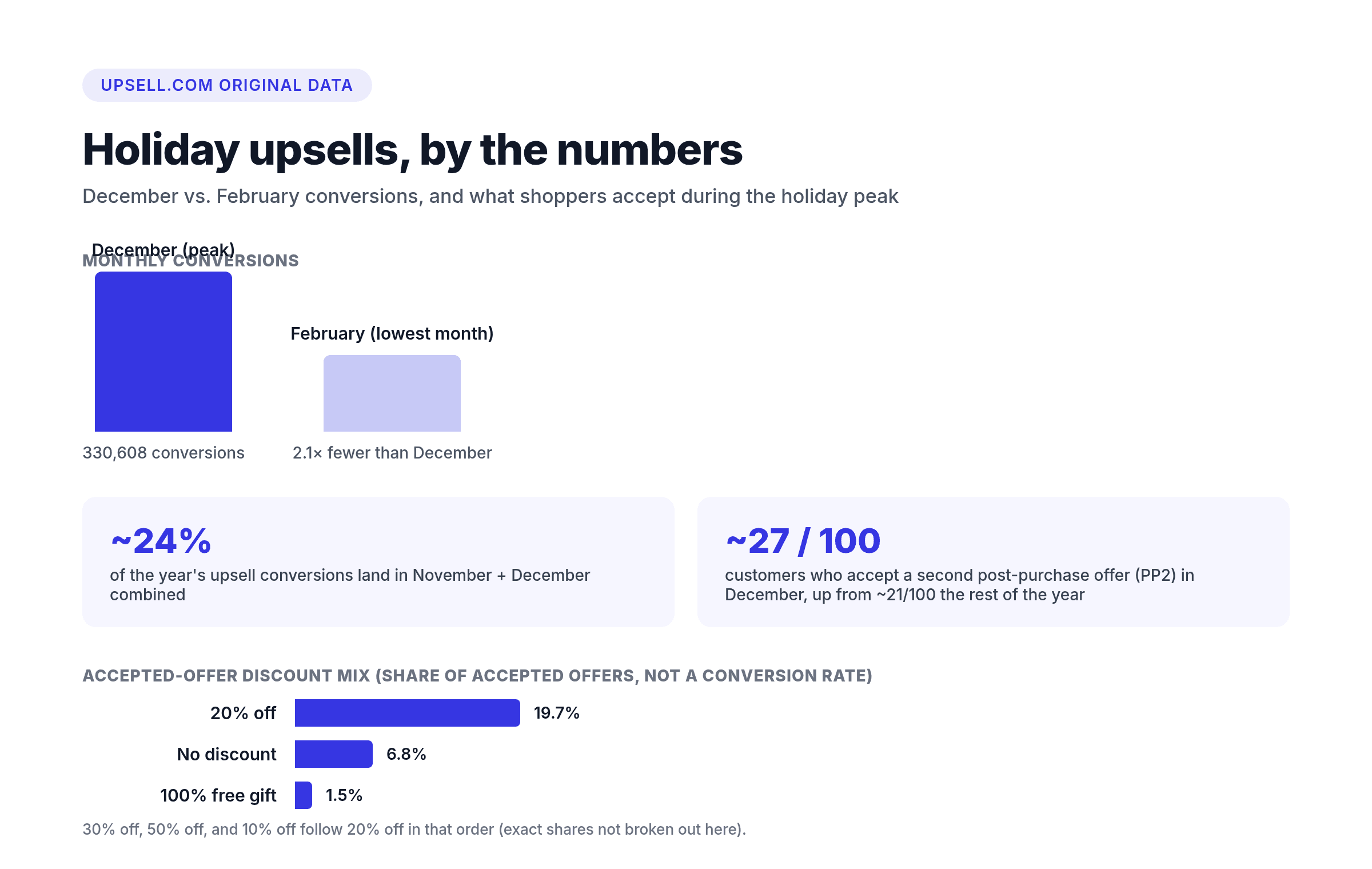
- November and December together account for roughly 24% of the year's total upsell conversions.
- December is the single peak month, with 2.1x the conversions of February, the slowest month of the year.
- Shoppers who accept a second post-purchase offer (PP2) rise to about 27 per 100 in December, up from roughly 21 per 100 the rest of the year.
- A 20%-off discount is the single most common choice among accepted offers all year (19.7%) - a reasonable default anchor for a holiday post-purchase offer.
What counts as a "post-purchase offer," exactly?
Before the stats make sense, a quick definition: a post-purchase offer (sometimes called a one-click upsell) is a deal you show a customer immediately after they pay, before they ever reach your thank-you page. Because they've already entered their card details once, accepting the offer takes one click - no new checkout, no re-entered payment info. Think of it as a post-purchase email with a 100% open rate: the customer is already standing right in front of you.
A lot of stores show a second offer (PP2) if the shopper accepts or declines the first - a second chance to pick up money that would otherwise be left on the table. That second-offer behavior is where the holiday data gets interesting.
How much bigger is the holiday season, really?
Let's start with the headline number: November and December together make up about 24% of the entire year's upsell conversions. That's roughly a quarter of annual volume landing in one-sixth of the calendar - the kind of concentration that makes a few hours of setup time in late October worth far more than the same hours spent in, say, March.
Zoom in further and December stands alone as the single busiest month of the year, with 2.1x the conversions of February, the slowest month on the calendar. That's not a modest bump - it's more than double.
December's upsell volume runs 2.1x February's, the widest swing of any two months in the year.
See the full picture in our upsell statistics breakdown, which covers the rest of the year's placement and seasonality data.
Post-purchase offers convert differently in December
Here's the part merchants don't usually expect: it's not just that there are more shoppers in December - the shoppers who do convert behave differently once they're already buying.
Across the year, roughly 21 per 100 customers who accept a first post-purchase offer (PP1) go on to accept a second one (PP2) too. In December, that number climbs to about 27 per 100. Picture a home-goods store running a single post-purchase funnel in July versus December - the exact same offer, shown to the exact same kind of customer, converts a noticeably larger share of second offers once the gift-buying mindset kicks in. It's the same logic that makes Amazon's "customers who bought this also bought" panel feel almost automatic to click during the holidays - shoppers are already primed to add one more thing to the pile.
That's the practical argument for running a second post-purchase offer specifically in Q4, even if you don't bother with one the rest of the year: the incremental acceptance rate is real, and it's concentrated in exactly the weeks when order volume is already highest.
What discount actually gets accepted?
One of the most common questions we get before BFCM is "how big a discount do I actually need to offer?" The honest answer, framed correctly: these are shares of accepted offers, not conversion rates - we don't have impression-level data, so we can't say how many shoppers saw-and-declined an offer, only what shoppers chose once they said yes to something.
With that framing in mind: a 20% discount is the single most common choice merchants use, accounting for 19.7% of all accepted offers across the year. Offers of 30%, 50%, and 10% off follow behind it in that order. Notably, 6.8% of accepted offers carried no discount at all, and 1.5% were a 100% free gift rather than a percentage off. In other words, a chunk of customers accept post-purchase offers with no discount attached whatsoever - proof that relevance and timing matter as much as the size of the deal.
For a holiday post-purchase offer, 20% off is a reasonable, well-tested starting point rather than an arbitrary number - and it's exactly the kind of accepted-offer pattern our Black Friday upsell checklist builds its setup steps around.
Why this matters more than a sitewide sale
Plenty of Black Friday marketing advice focuses on front-end discounting - and there's a place for that (see our broader Black Friday marketing guide for those tactics). But the data above points to a complementary lever that's easy to miss: the moment right after a customer has already decided to buy is when they're most receptive, and that receptiveness is measurably higher in November and December than any other time of year.
If you only optimize one thing before the holiday rush, the post-purchase moment - with a well-chosen discount and a thought-out second offer - is where the data says to spend your remaining setup hours.
Black Friday & holiday upsell statistics FAQ
How much bigger is Black Friday/December for upsells compared to the rest of the year?
December is the single peak month, with 2.1x the upsell conversions of February, the slowest month. November and December combined make up about 24% of the year's total upsell conversions.
Does a bigger discount convert better during the holidays?
Our data can only speak to what shoppers choose once they accept an offer, not how discount size affects whether they accept in the first place (no impression data exists). Among accepted offers, 20% off is the single most common choice all year, including the holiday season.
Should I show a second post-purchase offer (PP2) during BFCM?
The data supports it: acceptance of a second post-purchase offer rises to about 27 per 100 in December, compared with roughly 21 per 100 the rest of the year - a meaningful lift concentrated in exactly the weeks when order volume is highest.
Is this data specific to Black Friday weekend, or the whole holiday season?
It covers full-month data for November and December, not an isolated Black Friday/Cyber Monday weekend count. We report it this way because setup decisions (discount size, funnel structure) apply across the whole season, not just one weekend.
About this data (and how to cite it)
The statistics in this article come from aggregated, anonymized conversion data across thousands of Shopify stores running Upsell.com (formerly ReConvert), covering October 2025 through October 2026. Placement and discount figures reflect accepted offers, not impressions or conversion rates, since no impression-level tracking exists yet. If you'd like to cite this data, please link back to this page or to our full statistics breakdown.
Get more from every order
Upsell.com helps you increase AOV with targeted offers across the full shopping journey, from product and cart to checkout, post purchase, and beyond.