The Definitive Guide to Shopify Dropshipping (Examples, Products, Strategies & More)
Dropshipping has a reputation problem: half the internet says it made them rich, the other half says it's dead. The truth is less dramatic — it's a real retail model with thin margins, and the stores that win treat it like a business, not a lottery ticket. This guide covers how it actually works on Shopify, how to start properly, and the order-value math that decides whether you keep going.
Key takeaways
- Dropshipping is a fulfillment model, not a business model — you still need a brand, an audience, and unit economics that work.
- Margins are thin by design, which makes average order value the lever that matters most.
- In our data across real stores, 88.4% of upsell conversions happen after payment — the moment most dropshippers never use.
- Among accepted upsell offers, 20% is the most common discount — you don't have to destroy your margin to grow the order.
What is dropshipping, exactly?
You sell products in your own store at your price; a supplier ships them directly to your customer and charges you their price. You never buy inventory up front, never rent a warehouse, never pack a box. Your profit is the gap between those two prices, minus apps, payment fees, and — above all — the ads it took to win the order.
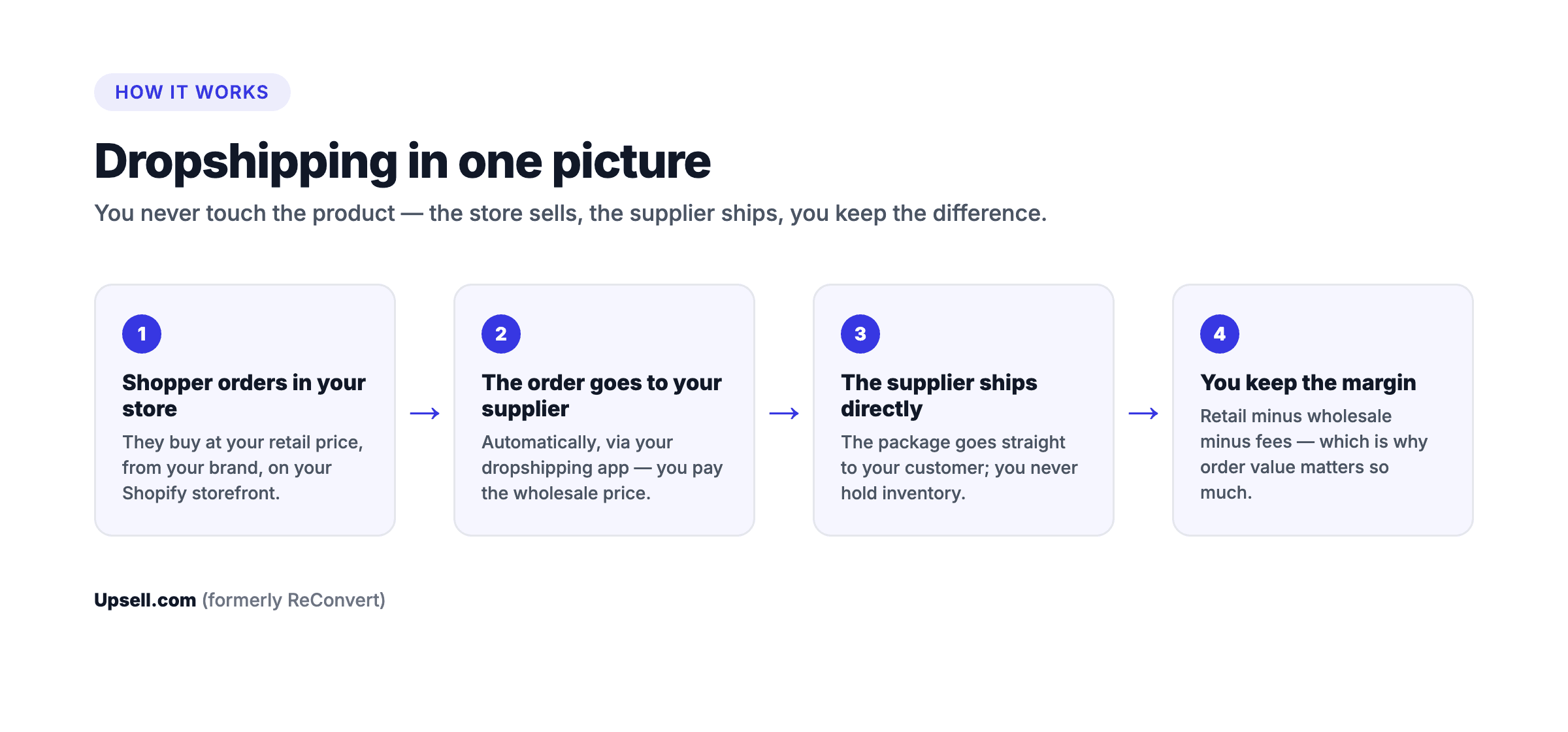
Why Shopify for this? Because the whole machine is plug-and-play: dropshipping apps sync products and route orders to suppliers automatically, payments and checkout are handled, and the app ecosystem covers everything else — so your actual job is picking products people want and selling them well.
The honest pros and cons
What's genuinely great: you can start with very little money, test products without buying stock, sell worldwide from your laptop, and change direction in a weekend when something doesn't sell. Failure is cheap — which is exactly what you want while you're learning.
What the gurus skip: everyone can see the same suppliers you can, so competition is brutal; shipping times depend on someone else's warehouse; returns are messier when a third party shipped the box; and the margins — there's no way around it — are thin. A typical dropshipped product might cost you $12 and sell for $30, and after payment fees and advertising, that gap shrinks fast.
How to start, in seven steps
1. Pick a niche you can say something about. “Trending gadgets” is not a niche — it's a feed. Pick an audience (home baristas, new dog owners, small-apartment living) and serve it.
2. Find suppliers you'd trust with your own order. Use a dropshipping app to source products, then place a test order from your own store and judge the unboxing like a customer would: speed, packaging, quality.
3. Build a store that doesn't look dropshipped. Rewrite the supplier's product descriptions in your own voice, use clean photos, and put shipping times where shoppers can see them before checkout — honesty converts better than surprise.
4. Price for profit, not for ego. Work backwards: product cost + fees + a realistic ad cost per order, then make sure the price clears it with room to breathe. If it doesn't, the product fails on a spreadsheet before it fails in public.
5. Launch with a few products, not fifty. A tight catalog is easier to advertise, easier to bundle, and easier to learn from.
6. Drive one traffic channel properly. Short-form video, search, or paid social — master one before adding another. Spreading a small budget across four channels is how test budgets die.
7. Read the numbers weekly. Cost per order, average order value, repeat rate. Kill losers quickly, double down on what moves.
What products actually work?
Forget chasing one viral winner. The products that sustain dropshipping stores share traits: they solve an everyday problem, they're light and cheap to ship, they're hard to price-compare (no famous brand), and they invite add-ons — because accessories and refills are where the order grows. A $25 product with three natural companions beats a $60 one-off.
Get more from every order
Upsell.com helps you increase AOV with targeted offers across the full shopping journey, from product and cart to checkout, post purchase, and beyond.
The margin problem — and the lever that fixes it
Here's the math nobody puts in the YouTube thumbnail. If your ads cost $15 to win a $30 order and the product costs $12, you just worked for less than free. You can't easily make ads cheaper or the product better — but you can make the order bigger, and the shopper who just bought is the easiest person in the world to sell to.
Our platform data — roughly 2.5 million upsell conversions across 11,000+ stores — shows exactly where that happens:
88.4% of upsell conversions happen after the shopper has paid — and the first one-click post-purchase offer alone carries 56.0% of them.
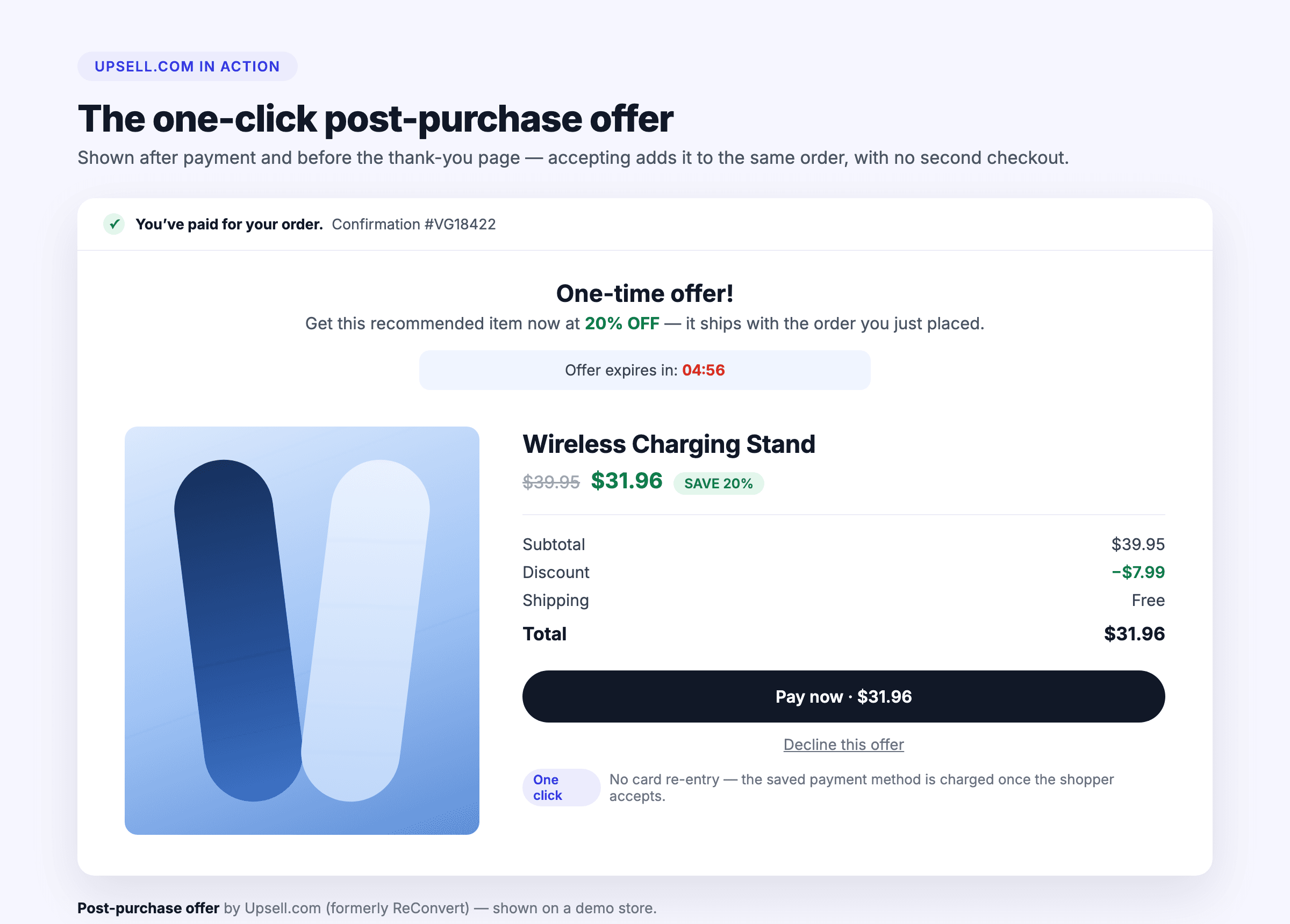
A one-click post-purchase offer appears between payment and the thank-you page. Accepting adds the item to the same order — no second checkout, no re-entered card — which is why it converts like a post-purchase email with a 100% open rate. For a dropshipper, that's the difference between a $30 order and a $45 one on the same ad spend.
Three placements worth setting up on day one:
- A post-purchase offer with a natural companion product — the charging cable to the mount, the filter to the machine.
- A thank-you page that sells — recommendations and a timed offer instead of a dead end; yes, the three-to-one gap between post-purchase and everything else from the takeaways is real.
- Quantity breaks on consumables — two-packs and three-packs raise the order before checkout.
And keep discounts sane: among accepted offers, 20% is the most common depth. The full numbers live in our upsell statistics report and the post-purchase guide.
Mistakes that end dropshipping stores
Chasing winners instead of audiences — when the product trend dies, the store dies with it. Competing on price — someone will always go lower; compete on brand and experience. Hiding shipping times — the refund requests cost more than the honesty would have. Ignoring the back end — no post-purchase offers, no email follow-up, no abandoned-cart recovery — leaving every order exactly the size the ad bought.
FAQ
Is Shopify dropshipping still worth it?
As a shortcut to passive income — no. As a low-risk way to start a real e-commerce brand without inventory — yes. The model rewards operators who treat margins seriously and build order value from the first sale.
How much money do I need to start?
Less than almost any other retail business: a Shopify plan, a dropshipping app, and an ad-testing budget. The bigger investment is time — product research, store copy, and creative testing.
How do dropshippers make a profit with thin margins?
Order value and repeat purchases. Bundles and quantity breaks before checkout, a one-click offer after payment, and email flows that bring buyers back — the same ad spend, meaningfully more revenue per order.
Do I need a registered business to dropship?
Rules vary by country — many people start as sole proprietors and register as they grow. Check your local requirements for taxes and consumer rights; this guide isn't legal advice.
About this data (and how to cite it)
The statistics in this article come from aggregated, anonymized Upsell.com (formerly ReConvert) platform data: roughly 2.5 million upsell conversions across 11,000+ active stores over the last 12 months. Placement and discount figures are shares of accepted upsell offers. Cite them with a link to this page or to our statistics report.
Get eCommerce insights that convert
One email a month, practical strategies on conversion, AOV, retention, and customer experience.